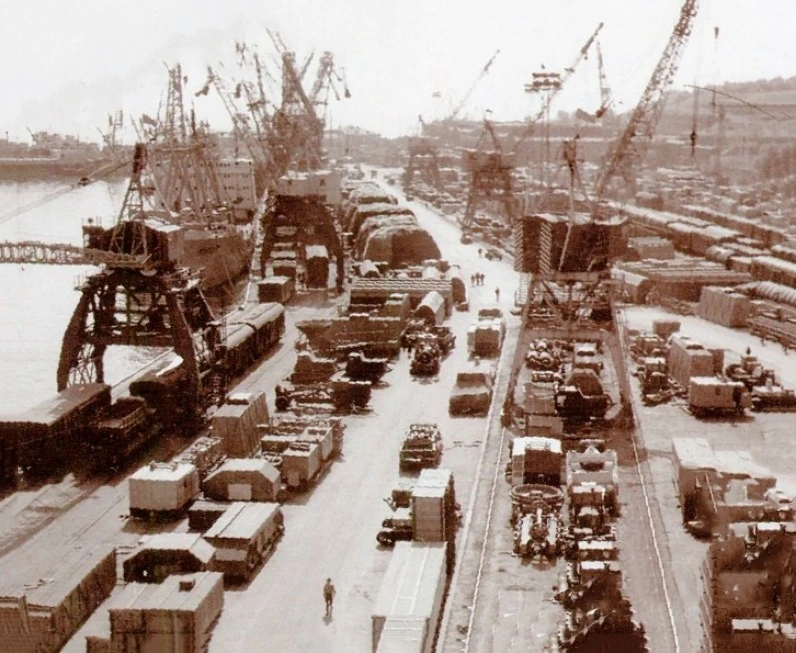
CRANES OF INVASION
As part of the project “The Incredible Port”
April 1944. Odesa had just been liberated from German-Romanian occupation, and the port, once powerful and bustling, had been reduced virtually to ruins. The surviving berths could be counted on the fingers of one hand, and there were no lifting mechanisms left at all: some had been evacuated in time, while the rest were either blown up or taken away by the occupiers. And despite this, it was precisely at that time that the Port of Odesa was assigned a strategic role — to become the main transshipment base on the Black Sea for the cargoes of the Anti-Hitler Coalition. The task was vast, yet there was no equipment.
In 1945, the largest single delivery of crane equipment in the enterprise's history was carried out: the United States sent twenty portal cranes of the 'Washington,' 'American Hoist,' and 'Clyde' brands to Odesa. These machines were unique: they were designed for war, for the Allied landings in France and Italy, where the crane had to be set up directly on an undeveloped shore. Unsurprisingly, they were called 'invasion cranes.' In Odesa, however, they became the machinery of revival.
As soon as the American 'giants' were assembled, they were immediately put into operation at the Quarantine and New Moles, as well as along the Bakaliyna Embankment. The flow of cargo was continuous: Lend-Lease supplies, factory equipment, raw materials, and humanitarian aid from UNRRA. Thanks to these cranes, by 1947 the port's cargo turnover had reached 7 million tons — more than before the war. In fact, it was these cranes that ensured Odesa's rapid return to life.
Working with the 'Americans' was not easy. Each crane had its own direct current diesel generator, so they were operated by three specialists at once: a crane operator, a motor mechanic, and a fitter. This was costly, and the engines, which had already served their time during the war, quickly required repairs. In the early 1950s, the port found a solution: a centralized power substation was built, and the cranes were converted to the new system. This extended their service life by several more decades.
Years passed, generations of port workers changed, yet these machines stubbornly continued to operate. In the 2000s, a port technical department archive accidentally revealed a port plan as of January 1, 1972 — and it still listed the same twenty American cranes delivered in 1945: seven 'Clydes' with a lifting capacity of up to 46 tons, eight 'Washingtons' — up to 35 tons, and five 'American Hoists' — 10 tons. The equipment that had gone through landings, war, oceans, and reconstruction proved remarkably durable — and became a part of the history of the Port of Odesa, which they had helped lift from the ruins.