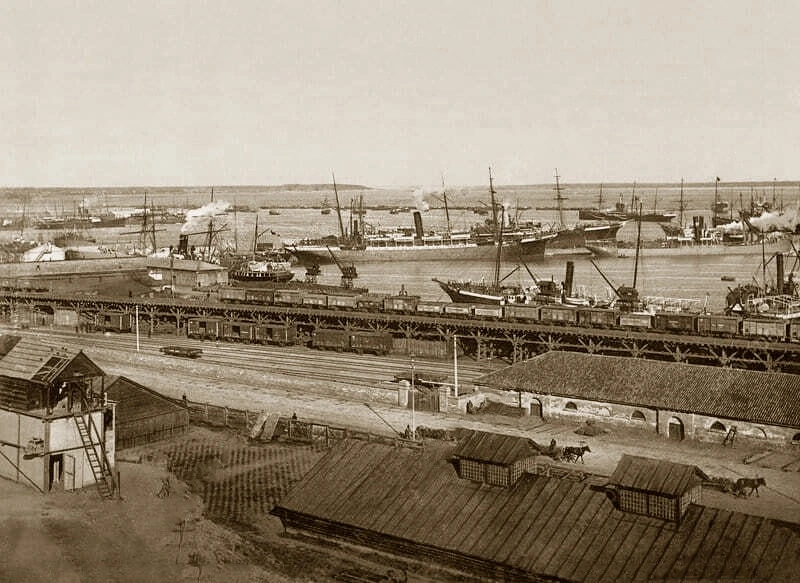
History of the Port of Odesa: Unknown Details
As part of the «Incredible Port» project
The New Year is a time of wonder, delightful surprises, and enriching intellectual pursuits.
Following this tradition, in the New Year’s edition of the “Amazing Port” project, we invite you to take part in a micro-quiz on the history of the Port of Odesa.
This compilation of lesser-known biographical details of the eminent enterprise is based on materials from the rare reference work Odesa–19th Century: A Chronicle (Odesa: Optimum, 2012; by N. Hlushko, V. Hlushko, and Yu. Shcherbakova).
We hope that this activity, where intuition and bold thinking compete with erudition, will bring you enjoyment. Test yourself. The correct answers, as is customary, await you below.
1. POSSIBLY A “FERSHAL”?
1806. The Odesa Quarantine becomes the central quarantine facility on the Black Sea. The staff numbers 40 employees; however, there are only three medical officials: a staff physician, a pharmacist, and
a) a feldsher,
b) a sanitary orderly,
c) a midwife.
2. BAKUN TOBACCO AND MOKANI CANDLES
In 1831, the steamship Neva set out on its first voyage from Odessa to Constantinople. The vessel carried to Turkey:
a) letters of credence for the Divan — the supreme state council under the Grand Vizier,
b) gifts from the imperial court for Sultan Mahmud II of the Ottoman Empire,
c) the following goods: ordinary strip iron, third-grade flax, tallow candles, moccasins, hemp seeds, Ukrainian leaf tobacco, and black sheep’s wool.
3. WHAT BRINGS YOU TO ODESA, HOLMES?
1856. A certain Mr. Holmes arrives in Odesa from London. The purpose of the visit:
a) a secret investigation into a major speculation on the Odesa Exchange, as a result of which British merchants suffered losses, while the incomes of 19 trading houses in Odesa exceeded one million silver karbovanets,
b) an attempt to improve the electrical machine of the Frenchman Nollet at the port lighthouse (the first electric generator in the empire),
c) collecting information for an expanded and revised edition of “The Atlas of the Black and Azov Seas” by Édouard Tetbu de Marigny.
4. A VERY “USEFUL” STEAMSHIP
1888. That winter, 78 steamships froze in the harbors of the Port of Odesa. Losses from their downtime exceeded 20,000 karbovanets per day. To free the merchant fleet from the icy trap, the ROPiT steamship “Polezny” (“Useful”) with a reinforced hull was dispatched, which was used in the port as an icebreaker. This icebreaker:
a) rescued no one and became the 79th steamship frozen into the ice,
b) carried out rescue operations, but only for British steamships,
c) rescued all vessels one by one over the course of an entire month.
5. AN UNREALIZED PROJECT
1888. In the era of monumental architectural constructions, when the Statue of Liberty was erected in the United States (New York, 1886) and the Eiffel Tower was built in France (Paris, 1889), the sculptor Antokolsky sent to the Russian Academy of Arts a “colossal-sized” design for a lighthouse for the Port of Odessa entitled:
a) “Christ Walking on the Sea”,
b) “Aphrodite Anadyomene, Emerging from the Sea Foam”,
c) “Mercury — the God of Commerce, Profit, Intelligence, Agility, and Eloquence, in a Winged Cap and Sandals”.
6. THE MYSTERIES OF THE BLACK SEA
1890. An oceanographic expedition aboard the gunboat Chornomorets (scientific staff of the expedition: I. B. Shpindler, F. F. Wrangel, N. I. Andrusov) made a sensational discovery:
a) for the first time, it excavated marble remains of the Temple of Achilles on Snake Island,
b) for the first time, it detected hydrogen sulfide contamination in the deep waters of the Black Sea,
c) for the first time, it classified dolphins as "intelligent beings endowed with cognitive abilities surpassing those of other human individuals, and by their nature always sober and incorruptible".
Correct answers:
1) c; 2) b; 3) b; 4) a; 5) a; 6) b.