“The Sand Line” of the Port of Odesa and Its Role in the City’s Development in the 1960s–1980s
As part of the project «Incredible Port»
In June 2014, an incredible event occurred in Odesa: the shoreline of several beaches popular among residents was suddenly struck by a three-meter wave. In particular, near the beach of Chornomorka Beach, the sea suddenly overflowed its banks, sweeping people into the water. Fifteen people were swept into the sea, with three children taken to the hospital. Fortunately, no deaths were reported.
The fury of nature subsided within moments, leaving behind the question: what, exactly, had just happened?
Scientists could not identify any earthquakes or explosions. Only later did a commission cautiously suggest that it might have been a mini-tsunami caused by a collapse of seabed soil… in an area where sand had once been extracted.
Thus, the sea reminded Odesa of one of the least known yet decisive chapters in its history – the “sand line” of the Port of Odesa.
In the 1950s, sand for construction purposes in Odesa was taken directly from the shore between Langeron and Arcadia. Dredgers operated opposite the beaches, and it seemed as though the sea felt no pain. But by the late 1950s, Poseidon responded: the odd-numbered side of Chornomorska Street was claimed by the water.
After that, the dredgers were urgently relocated to Zatoka. Yet only a year and a half later, that resort settlement also began sliding into the sea. It became clear that sand had to be sought elsewhere.
At that time, the management of the Black Sea Shipping Company made a decision that eventually, in essence, changed the appearance of Odesa. Sand extraction began near the Tendrivska Spit – in the bend of the Dnipro-Buh Estuary, near the Tendrivska Spit (the so-called Pokrovski Khutory).
It was almost an ideal solution. The sand was freshwater, high quality, and suitable for producing superior wall panels.
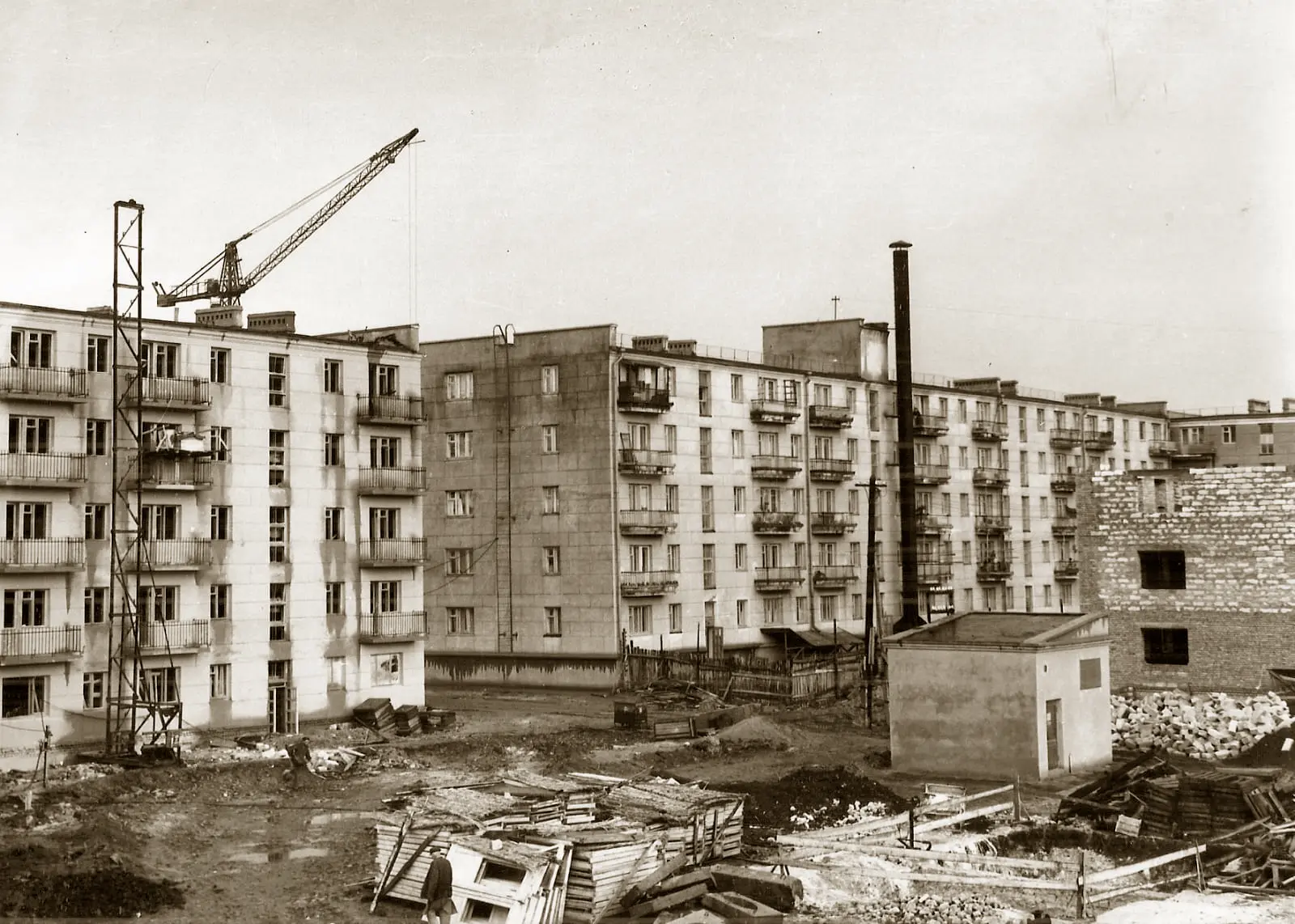
Thus emerged the tug-and-barge cargo route “Odesa Port – Tendra – Odesa Port,” which effectively marked the beginning of the Khrushchev-era mass housing development in the city.
From the memoirs of Mykola Palahin, a veteran of the port fleet of the Port of Odesa:
— “We transported sand very intensively. It was being dredged around the clock with a grab by a floating crane. The port’s steam tugboats ‘Berezan,’ ‘Solntsedar,’ ‘Vagranshchik,’ and others hauled barges from April through October, right up to the winter storms. No days off or holidays. In the port, the construction material was unloaded by two Ganz portal cranes at Berth 29 of the Grain Harbor (now Berth 43). Considering that four 1,000-ton and three 500-ton non-self-propelled barges were involved, and each could complete a round trip per day, it is easy to calculate that the port supplied 4,000 – 5,000 tons of sand daily to the house-building plants. That amounts to 120,000 – 150,000 tons per month and over 800,000 tons per year.”
It was a true sand conveyor – and it operated for decades without stopping.
According to approximate estimates, in the 1960s–1980s about 1,000 (!) “Khrushchevkas” (five-story apartment buildings of the Khrushchev era) were built in Odesa: 560 in the Southwestern Massif (Cheryomushky), 200 on Fontan, 100 in the Kotovsky settlement, 40 each in Tairova and Moldavanka, 30 on Balkivska and Shchorsa streets, 20 on Peresyp, and 10 in the city center.
The overwhelming majority of these buildings stand on sand delivered by port workers. In fact, entire residential districts of the city grew out of the estuary bottom transported by barges.
An interesting fact: by the end of the Soviet era, another ‘sand line’ operated in the port from time to time. When the port fleet failed to meet the monthly target in ton-miles, tugs would tow sand barges between the berths of the northwestern and southeastern areas of the port.
A barge would be loaded in the Harbor, towed to the Quarantine Harbor for unloading, and then the process would repeat in reverse. And again. Everyone knew it was absurd – but without meeting the plan there would be no reports, and no bonuses.
Today, residents of Odesa’s five-storey neighborhoods rarely stop to think about what their apartment blocks, schools and kindergartens are built from. But the sea remembers. And from time to time, it reminds the city – with a sudden wave, a landslide, a crack in the shoreline. This was the price the city paid for the happiness of tens of thousands of families who once moved from cramped dormitories and communal flats into private apartments with modern conveniences. For many new residents of Odesa in the 1960s – 1970s, the relentless work of the port’s “sand line” was not just logistics – it was a lifeline.