
The Sailor’s Wife Sailing Toward Love
As part of the project “Incredible Port”
In many port cities around the world, there are monuments to those who wait for sailors. In Barcelona, Gloucester, Marmaris, Oslo… Usually they depict women standing on the shore, gazing out to sea and waiting for ships to return.
But in Odesa, everything is different.
Here, she is not simply waiting. It feels as if she is sailing.
The sculptural composition was installed in 2002 for the City Day celebration. A young woman in a light summer dress stands with her small son on the parapet near the passenger terminal. They look out to the sea – toward the place where a ship will soon appear, bringing a husband and father back home.
Her silhouette is considered one of the most romantic among monuments of this kind. And that is no coincidence: the sculptor, Honored Artist of Ukraine Oleksandr Tokarev, created the figure using a ballerina as his model. That is why there is such grace in her posture, movement in her lines, and lightness in the whole figure – as if the sea wind might lift her at any moment.
But there is one more detail that makes the Odesa sailor’s wife unique.
She is not meeting her beloved on the shore.
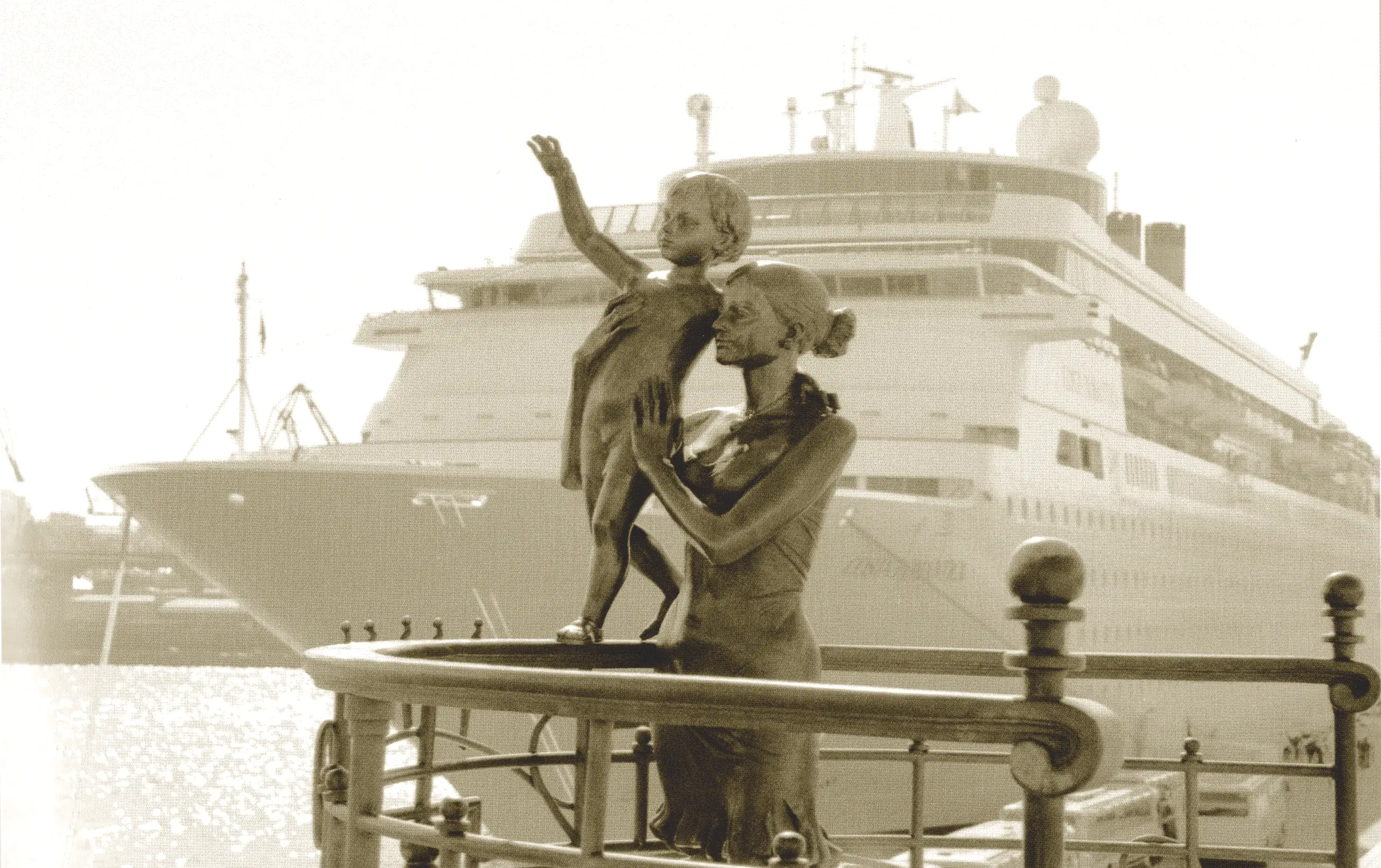
The platform on which the sculpture stands is designed to resemble the bow of a boat. It creates the impression that the woman is standing on deck, setting out to meet the ship. This is not just an artistic idea – it is a living memory of an entire era.
This image also has a real story behind it. In the 1960s–1980s, when Odesa was one of the key ports of the Black Sea Shipping Company, ships sometimes waited outside the harbor for hours or even days before entering the port. And small boats would go out to meet them – carrying the sailors’ wives, children, and mothers.
To see each other.
To say a few words.
To make sure: he had come back.
This very moment is captured in bronze. The sailor’s wife is not simply waiting – she is crossing the distance. She is not a passive figure on the shore. She is part of the movement, part of the sea, part of the great history of the port.
It is a monument to love that endures through every storm. A monument to women’s strength and devotion.
And at the same time – a memory of the “golden age” of maritime Odesa, when the city lived to the rhythm of ship horns, voyages, and homecomings.
Perhaps that is why it still feels as if she is looking toward the horizon.
Because someone is always returning to the port.