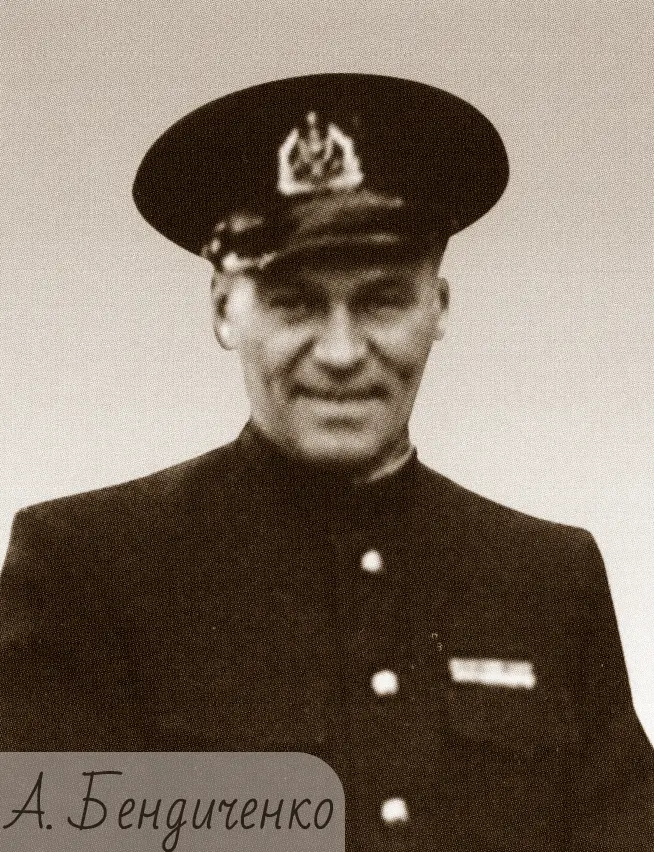
“The Valley of Wrath” of Anatolii Bendichenko
As part of the “Incredible Port” project
There are places in the Port of Odesa that cannot be found on any map. They have no signs, and they are not mentioned in guidebooks. Yet it is in such places that true character is forged — the character of both the port and its people.
In the 1950s and 1960s, there was such a place behind Berth No. 14, overgrown with vines. It was known as the “Valley of Wrath”. The name sounded almost legendary — carrying a sense of danger and respect. And there was someone to live up to it.
Anatolii Kyrylovych Bendichenko joined the port in May 1945, at a time when the port looked more like a shattered skeleton than a living organism. Cranes stood like charred frames, the quays were buried under rubble, and the warehouses were empty and destroyed. It was not simply a matter of getting back to work — everything had to be started from scratch.
He knew the sea. As a young man, he served in Kronstadt and later sailed aboard vessels of the Black Sea Shipping Company.
But a port is more than water and ships. It is people, machinery, nerves and responsibility. Bendichenko accepted this challenge in the way people of his generation did: without unnecessary words.
The Second District, which he headed, was literally rebuilt piece by piece. Rubble was cleared, machinery restored, and people learned to work all over again. When necessary, he would roll up his sleeves and join the stevedores in unloading vessels. When necessary, he would oversee machinery repairs until late at night.
And it was then, amid the noise of welding, the smell of grease and the surrounding vines, that the “Valley of Wrath” was born.
Forklifts were repaired there — machinery without which the port would become an immobile giant. And if a machine failed to make it onto the working line, if there was dirt or disorder somewhere, Bendichenko would come to inspect the site. And then the valley truly became a place where his anger could come down with full force.
He was strict. Very strict. For him, discipline was not a formality — it was a matter of survival and efficiency. In a port, there could be no “later” or “somehow”. Either the work got done, or the entire process came to a halt.
It is said that mechanics would sometimes hide among the vines when they saw the manager approaching for an inspection.
But this was not so much about fear as it was part of a unique port culture — filled with humour, ingenuity and respect for a strong leader.
Because behind that strictness was something else.
He knew how to be simple and approachable. He could sign an application right on the quay — on someone’s back, without stepping away from the work. He disliked unnecessary bureaucracy when people were concerned. And he knew how to stand up for them.
In 1947, one of the employees of the transport and forwarding office of the Second District, acting out of kindness, agreed to help a forwarding agent and released coal ahead of schedule. A few days later, that coal appeared on the market. Under the laws of the time, this was a serious offence, and she faced imprisonment.
When Bendichenko learned what had happened, he did not stand aside. He went to the investigator, looked into the circumstances and secured a fair resolution. He did not simply manage people — he took responsibility for them.
Mykola Pavliuk, the legendary former head of the Port of Odesa, who once worked under Bendichenko, adopted many of his management practices and leadership principles.
Over twenty years of his tenure, the Second District became one of the port’s best-performing divisions.
Plans were fulfilled ahead of schedule, while the district handled some of the most challenging cargoes from around the world — from India, Cuba and Egypt. Its records were recognised far beyond the port itself.
But perhaps the most important thing he left behind was not the figures, but the memory. The memory of a man who could be as formidable as a storm and as straightforward as a conversation on the quay. Of a place where discipline was forged amid vines and steel. Of the “Valley of Wrath”, which became more than a geographical location — it became part of the soul of the port.
Stories like these do not disappear. They remain — in the memories of veterans, in the character of new generations and in the very rhythm of the port.
Because a port is not only about steel and concrete. Above all, it is about people.